You Don’t Have to Add More to Teach Students How to Think: Upgrading Your Students’ Brain Engine
Where Literacy Meets Science-Literally
From In the Draft — Dr. Nicole Moriarty's Substack
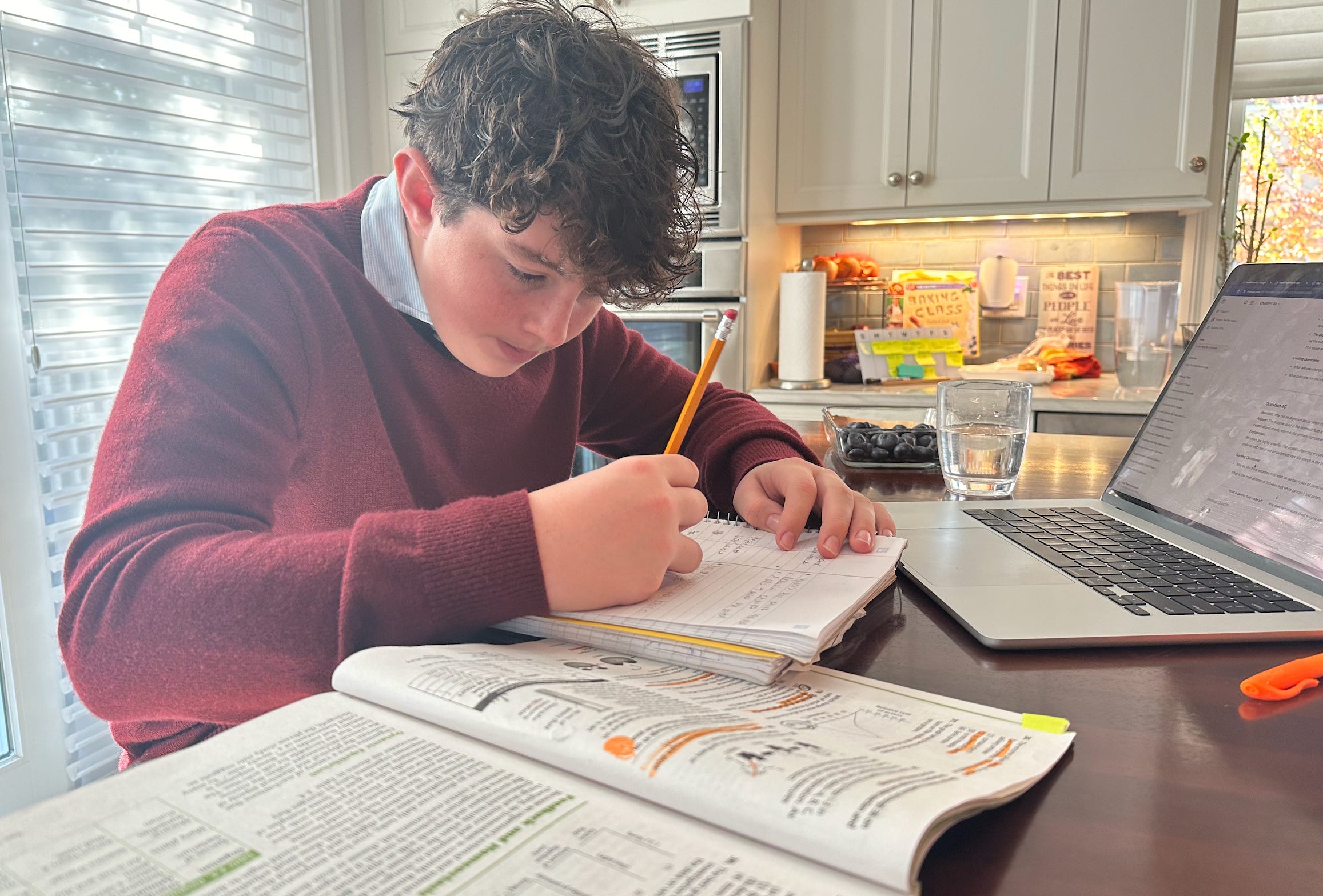
This is Nicole’s son in middle school, working from his science textbook, taking two-column notes, and using AI to support him when needed. He now uses the two-column note routine to encode (learn) all of his subject areas. Nicole brings the science of learning to science in her home every day.
Bonus Audio! Put your earbuds in, go for a walk, and listen. Come back later and make sure to read the article as well!
It started with a quick phone call after a science director’s meeting—one of those conversations that sticks with you.
Nothing formal, just two colleagues swapping thoughts about how to help students truly comprehend what they read, see, and do in science.
Five minutes in, we found ourselves saying the same thing: our science teachers are carrying so much already.
New standards. High-stakes tests. Complex labs. Heavy content. And through it all, a genuine desire to help kids think critically and make meaning from the work.
That call put a log on our fire.
Because this is the work we love—the intersection between content and comprehension, between knowing and thinking, the challenge isn’t that teachers don’t want to teach literacy; it’s that they can’t afford to add one more thing.
So this week’s post is about precisely that: how to help students comprehend without adding more.
Comprehension is making meaning.
That’s it.
Not just from what’s read, but from what’s also said and done.
In every classroom—from science to social studies to math—students are constantly trying to make meaning. And that’s really what comprehension is.
Now here’s the key: to make meaning, students have to think about their thinking. That’s metacognition. And the two things that make this work are vocabulary and background knowledge.
When students know 95% of the words on a page, they can start connecting ideas and truly understand what they’re reading. But to know those words, they need to have knowledge—lots of it. And they need to use those words in their conversations and in their writing.
That’s why we push so hard for interdisciplinary units of study from pre-K through 8th grade. The more students know, the easier it is to make meaning from anything—a textbook, a lab, a data table, even a demonstration—knowledge fuels comprehension.
And here’s the best part: we don’t have to overhaul our lessons to make that happen. We just have to build consistent routines around it.
So what can we do at the secondary level, regardless of what our students are coming in with?
Four Student Routines. That’s it.
Four simple student routines can transform how students understand complex content. And we promise—they’re not new, they don’t require a fancy program, and they won’t eat up your class time.
They are:
Student-Generated Questions
Graphic Organizers
Two-Column or Cornell Notes
Summarization
You’ve probably used most of these at one point or another. But here’s the secret: it’s not about using one of them occasionally—it’s about using a combination of them consistently.
That’s where the magic happens.
1. Student-Generated Questions
Let’s start with questions—because scientists are, by nature, questioners.
When students generate their own questions—about what they’re learning, what they’re seeing, or what they think they understand—they start owning their learning.
It’s active, not passive.
The good news? You don’t need a new system. Use what already works:
Bloom’s Taxonomy for levels of questioning.
Write questions in the margins or in the notebook
KWL (What I Know, Want to Know, and What I Learned) charts.
Or our personal favorite: the SQ4R method (Survey, Question, Read, Recite, Review, Reflect).
Even better, ask students to make questions during a lab or after watching a demo. You’re teaching critical thinking without adding a single worksheet.
2. Graphic Organizers
Research loves graphic organizers—and for good reason. They help students see how ideas connect.
But here’s where schools often go sideways: we give students too many. Every class uses a different one.
Now, put yourself in the shoes of a 14-year-old trying to keep up with six different subjects and six different ways of organizing information. That’s not helpful; it’s cognitive overload due to multiplicity.
So pick one or two organizers as a department or district (ideally). Teach into them deeply, and use them across grade levels.
That’s it.
If you do that, you’ve just given students a lifelong tool for thinking; a reliable structure for thinking.
3. Two-Column or Cornell Notes
Note-taking is not old-fashioned. It’s neuroscience.
When students write, they process, organize, and restate information in their own words. That’s comprehension in action.
We’ve lost so much of that because of 1:1 devices. But typing isn’t thinking. Writing is.
Two-column or Cornell notes are simple and powerful:
Left column: big ideas or questions
Right column: supporting details, explanations, data, examples
Bottom: a short summary ( We prefer a separate summary after the notes, but find what works for you and your kids)
Over time, students begin to see how ideas build on one another. And bonus—it’s metacognition again.
At home, Nicole uses this same structure with her own high schoolers (one of whom has learning differences and finds school challenging). It helps him see what matters most. It slows him down just enough to think. And guess what? It works.
When working with teachers, we teach them one graphic organizer. They commit to that as a district from pre-k on, and voilà, the kids have a ready-to-go routine that grows with them through the ages. And guess what? It works.
4. Summarization
If there’s one strategy backed by decades of research, it’s this one.
When students summarize, they’re forced to identify main ideas, integrate details, and make meaning. It improves both comprehension and writing—and it sticks.
The best part? It doesn’t need to be formal. Try these:
The 20-Word GIST: “Summarize today’s lesson in 20 words.”
The 12-Word Story: “If you could only explain this in 12 words, what would you say?”
Claim-Evidence-Reasoning: “Make one claim, give two pieces of evidence, and explain why it matters.”
It’s fast. It’s flexible. And it works in every content area.
This is a high-impact, informal move that lasts.
Why it Matters—Especially in High School
By grades 6–8, we often start to see cracks in comprehension. Students who seemed fine suddenly struggle to understand complex texts or lab directions. It’s not that they forgot how to read—it’s that the demands of comprehension skyrocketed, and they didn’t have the routines to support it.
And it’s showing up in national data. We saw the NAEP scores dip again this year for 12th graders. But we don’t have to accept that as the norm.
If we teach students to use these four routines consistently, we give them a toolkit that grows with them. It works for reading, for labs, for videos, for life. And it can and should be done throughout high school as the texts become more complex and the concepts introduced are more intricate.
So, How Do We Start?
The same way we teach anything: through gradual release.
I do: Model it. Think aloud. Show them what’s happening in your brain.
We do: Build one together—ask questions, annotate, fill in the organizer.
You do together: Let them try it with a partner.
You do: Step back. Let them own it.
That’s all it takes.
In the End
We’re not asking anyone to overhaul their curriculum or add a new unit plan. Habits take time, but that’s the point: don’t rip everything up and start again. Don’t create a new “thinking skills” class.
We’re saying:
Use what you already do—labs, readings, videos—and weave in these routines intentionally.
When students have consistent ways to question, organize, take notes, and summarize, they don’t just “read better.”
They think better.
And isn’t that what science—and learning—are all about?
The biggest leaps rarely come from something shiny or new. They come from rediscovering and recommitting to the simple, timeless moves that make thinking visible, more structured, more manageable, and more meaningful.
That quick phone call reminded us that sometimes the most significant shifts don’t come from a new program or a new initiative.
They come from rediscovering the simple, timeless (evidence-based) moves that make thinking visible. And science is all about that evidence.
Here’s to more of those five-minute conversations that light fires. Thank you, friend; we needed you on that day to remind us why we are doing this.
With love,
Nicole & Trici
If you want to learn more, read the National Reading Panel Report and access the Keys to Literacy website.
Thanks for reading!
This post is public, so feel free to share it.
This post was originally published on Dr. Moriarty's Substack.
Read the original on Substack