We Didn’t Finish Teaching Them to Read
Why the work continues after third grade
From In the Draft — Dr. Nicole Moriarty's Substack
As the school year has plodded along, I’ve taken a bit of a hiatus from writing and have been very busy running workshops for school districts, BOCES educational centers, and adjuncting at Bank Street. Needless to say, it has been wonderful meeting educators from all over the Island and reconnecting with old friends that I haven’t seen in ages. Also very cool to meet people who know people from the various stages of my career.
And while all of this was happening, different ideas kept popping into my head, swirling around, about all the things I could write about. At this point, I have a page-long list and, if I’m being honest, I want to write about all of them at once.
Yet one keeps resurfacing for me—reading.
Not just how we teach it in the early grades, but what happens after. The more I sit with it, the more I keep coming back to the same thought:
I’m not sure we ever really finished teaching our students how to read.
So that’s where we’re going to spend some time today.
Now, I know you may be saying, “Good grief, we are tired of hearing about reading; we know we need to teach reading to the little guys.”
Yes, we do know that.
And still, there are two ideas I want to share about literacy from the elementary grades to High School, along with one framework that I know works, one that, when done well, truly changes outcomes for kids.
Over the last few years, we’ve heard a tremendous amount about the Science of Reading. We understand that it is an interdisciplinary body of research spanning decades, across countries and languages, and that it gives us insight into how we learn to read and how to teach our children to do so.
We also know what it is not. It is not a fad or a pendulum swing. It is not a political agenda, although it is sometimes being made into one. And it is not a single program or one isolated component of instruction like phonics.
To help make sense of the complexity of reading, we’ve leaned on models like the Simple View of Reading, Scarborough’s Rope, and the Active View of Reading.
All of that matters.
And what I want to add to the conversation is this:
learning to read is not something that begins and ends in the early grades. It is a developmental journey that continues well into adulthood and requires ongoing, intentional instruction along the way.
If we break it down, we know that from birth through about third grade, children are learning how to read. They are learning how letters represent sounds, how those sounds connect to printed symbols, and how those symbols come together to form words. With practice, this work becomes increasingly automatic, and we begin to see students become fast, efficient word readers and understand what those words mean.
At the very same time, they are building their language comprehension. They are hearing and using words that far exceed what they can read independently. They are learning the complexity of sentences and how meaning is constructed through stories, conversations, and experiences. AND it is important to know that listening is still more efficient for learning new material than reading alone.
This is a massive undertaking, and with explicit instruction and deliberate practice, the brain quite literally reorganizes itself to make reading possible. It really is remarkable when you think about it.
Jeanne Chall identified this as the early stages of reading development in her 1983 work on the stages of reading.
But what is often overlooked in schools is that reading development does not stop there.
Chall’s Stages of Reading Development
When you look closely at Chall’s work, learning to read does not end at age eight or at the end of third grade. It continues into Stage 3, and then progresses into Stages 4 and 5—into high school, college, and beyond.
This is where I want us to spend some time.
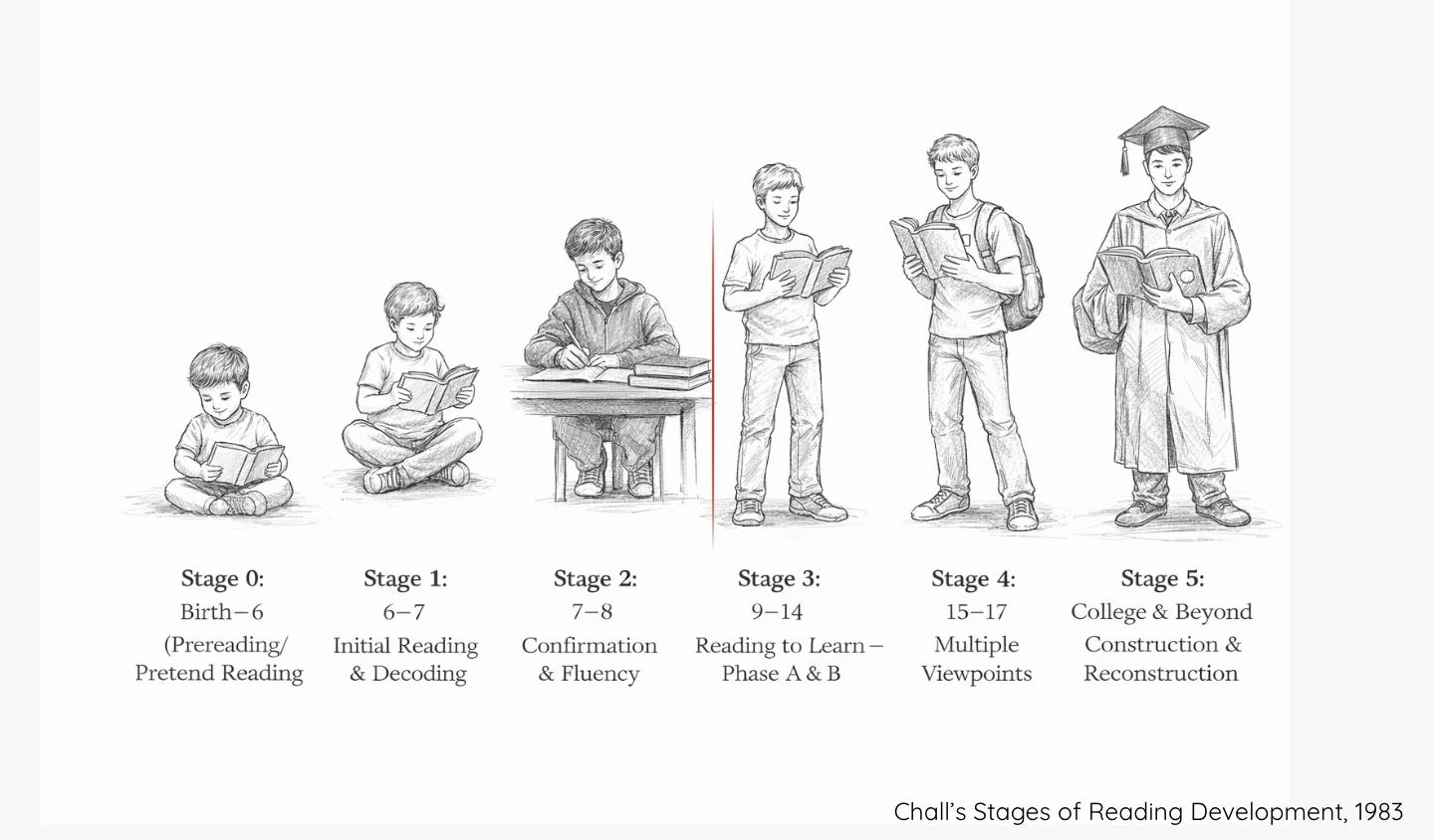
Stage 3—roughly grades 4 through 9—is the window we often miss.
This is also where I think we have unintentionally misinterpreted the idea of moving from “learning to read” to “reading to learn.” Somewhere along the way, that has turned into the belief that students should enter fourth grade already able to read independently and learn content with little to no ongoing literacy instruction.
What they actually come in with is the ability to decode and work through increasingly complex text.
And that is not the same thing as being able to independently use reading as a tool for learning.
In Stage 3, students are learning how to gain knowledge through reading—typically from a single perspective, across a range of texts: textbooks, trade books, articles, newspapers, and more.
Over time, they are expected to become independent in doing this, but that independence develops across the stage—it is not where they begin.
This growth requires continued instruction. It requires students to read increasingly complex texts, to study words and language in a systematic way, and to respond to text through discussion and writing across content areas.
Through that combination of explicit instruction and deliberate practice, students become truly skilled readers and, ultimately, strong comprehenders of the printed word.
There is another important layer here that we cannot ignore.
Stage 3 is divided into two phases—grades 4–6 and grades 7–9—and at the beginning of this stage, students’ listening comprehension is still stronger than their reading comprehension. It is not until later in the stage that those two begin to even out, and that is for strong readers.
The implication here is significant.
Our students still need to hear us read. They still need exposure to complex language delivered fluently so that their language comprehension continues to grow alongside their reading skills. AND this is how they really are, still learning about the world.
This is essential if we want comprehension to develop in the way we expect it to.
So what does this mean for us?
It means that from upper elementary through the early years of high school, we are working across multiple layers of literacy at the same time.
For some students, we are still building foundational skills—basic literacy. At the same time, we are building content literacy—supporting students in reading, writing, and learning across subject areas. And alongside that, we are developing disciplinary literacy—helping students think, read, and communicate like experts within specific fields. Joan Sedita does a beautiful job of breaking this down in The Essentials of Adolescent Literacy, which helps us see this work more clearly.
At this point, it is completely fair to wonder, “How are we supposed to do all of this?”
This is where I want to offer something very simple, and I credit Mike Schmoker for continuing to push this thinking in Focus: Elevating the Essentials to Radically Improve Student Learning.
Students need time—real time—to read, write, and speak every single day, in every class.
If we commit to this throughout the day and that time is supported by explicit instruction and deliberate practice, the gains our students make are significant. We often refer to this as the literacy formula:
Reading. Writing. Speaking.
It is simple, but it is powerful, and it works.
And when we turn again to what we know from research, it is clear that this combination, explicit instruction, paired with deliberate practice in reading, writing, and speaking, is what supports students in developing the kind of reading proficiency required for Stage 3. This is especially true for our most vulnerable learners.
I love this short video clip from Anita Archer, a highly skilled and respected educator, who explains the components of explicit instruction and the role of practice:
This is what prepares them for what comes next.
Stage 4 is where students begin reading widely, engaging with multiple perspectives, and making meaning from increasingly complex texts across disciplines. That kind of reading is not something students arrive at by chance. It is built, intentionally, over time.
As classroom teachers, we can begin to see what this looks like in practice.
This can’t live only in individual classrooms. If we want this work to take hold in a real and lasting way, we have to look just as closely at the systems that surround it.
The Framework that Changes Everything
Curriculum matters here—especially when it is grounded in knowledge building rather than a collection of isolated skills. That foundation shapes everything that follows. From there, it becomes about protecting what all students experience every day. Tier 1, core instruction, has to remain intact. No one should be missing that instruction for anything else.
From there, we have to think differently about how we provide support.
If we have the resources—and by resources, I mean reading teachers—we should be leveraging them in ways that strengthen, not separate, instruction. That means building capacity for team teaching, where Tier 2 support occurs within the classroom alongside core instruction. When classroom teachers and reading teachers are working together, using the same curriculum and instructional frameworks, the support becomes aligned, consistent, and far more effective. All students benefit from it, not just the ones identified for extra help.
And it also means we have to be much more intentional about how we structure Tier 3.
This is where WIN time can be incredibly powerful—if it is designed well. WIN period is simply a period where all students get “What I Need”. It is similar to an X block in scheduling, where no new instruction is occurring, but rather a period of time when students can continue to practice, receive individualized or small-group support, develop a passion project, and/or receive enrichment. It is a versatile period of time in which any combination of the aforementioned can occur.
When WIN periods are blocked and staggered by grade level, it allows us to assign reading teachers to specific grades. Those teachers then become deeply connected to the students they are supporting. They are not just pulling students out in isolation; they are part of the instructional system. They can co-teach for Tier 2 and then provide Tier 3 support during WIN.
When done this way, a few important things happen.
Students receive all three tiers of instruction without missing core learning.
The same reading teacher is working with the child across settings, which creates consistency and a much deeper understanding of that student’s needs.
And students can receive targeted support in one area while still having opportunities for enrichment in another.
We also begin to eliminate the constant movement of students in and out of classrooms, which, over time, adds up to a significant loss of instructional time.
And underneath all of this is time—time for teachers to plan together. Whether that happens through a scheduled common planning block or something like a 0-period, it matters. When teachers work from a shared curriculum and a shared understanding of instruction, the work becomes collective.
This is not about adding more.
It is about organizing what we already have in a way that actually supports how students learn.
When we think about middle school, where so much of this Stage 3 work lives, we have to be even more intentional about creating the conditions for students to continue developing as readers, so that they can learn from what they read and engage with increasingly complex ideas.
I know this is work we can do.
I have seen it happen, and there is nothing more powerful than a committed group of educators who are aligned in their efforts and clear about what matters most.
We can do this.
And more importantly, our students need us to.
This post was originally published on Dr. Moriarty's Substack.
Read the original on Substack