From Lemonade Stands to Passion Projects: Keeping the Spark Alive in Grades 4–8
What do lemonade stands, Shark Tank, and Rockaway Beach have in common? Dr. Nicole Moriarty & Mrs. Trici Broderick, MS.ED
From In the Draft — Dr. Nicole Moriarty's Substack
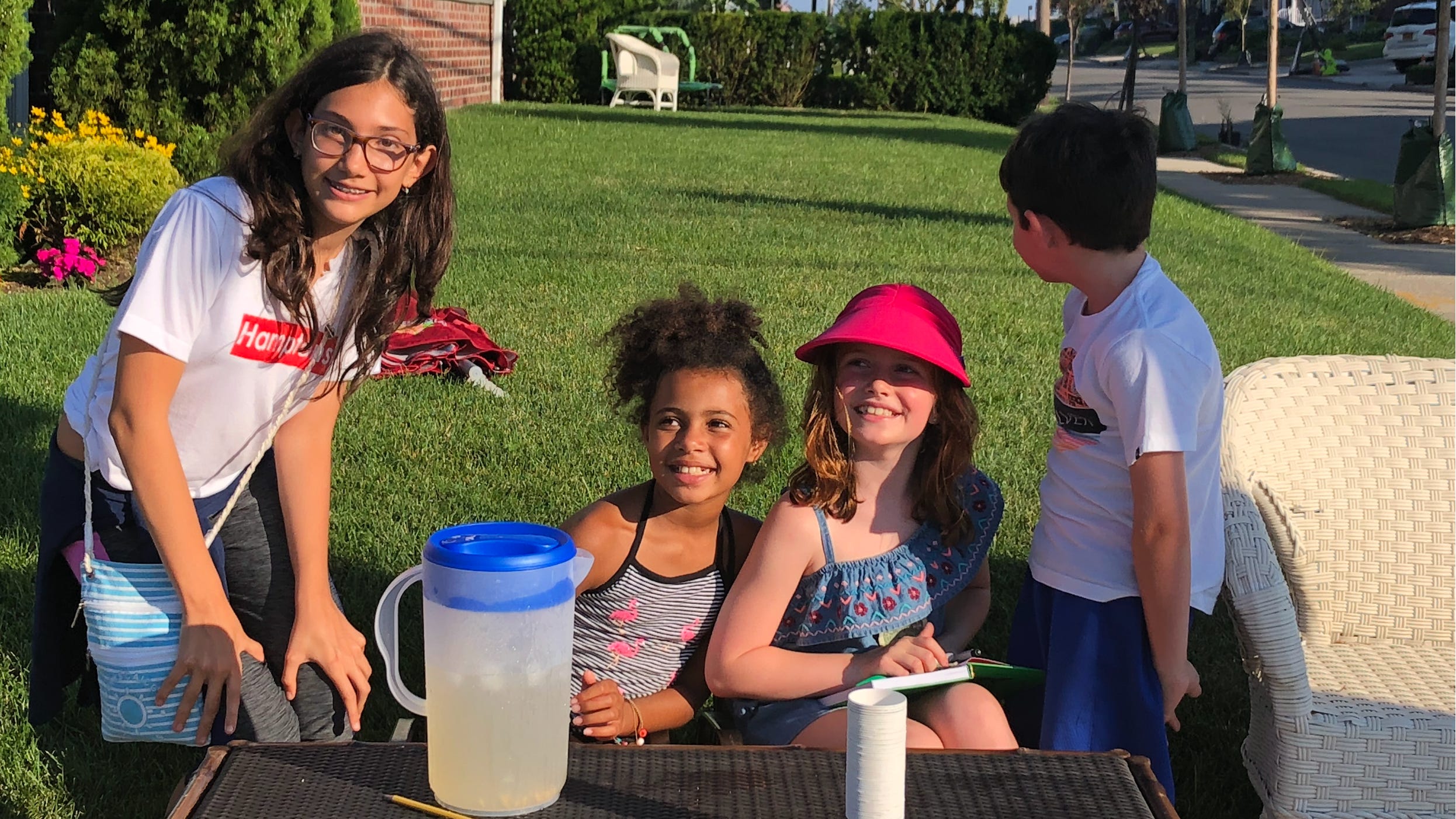
In our neighborhood—Rockaway Beach (are you humming the tune now, too?)—summer rituals aren’t just about bike rides, pool days, or beach afternoons. They’re about lemonade stands.
And when we say our neighborhood, we really mean it. We first worked together professionally before realizing that Nicole’s husband and Trici actually grew up right next door to each other here. Now, all these years later, Nicole lives next door to Trici’s brother. Life has a funny way of weaving circles back together.
Watching Charlotte and her friends set up their first lemonade stand here was like watching a case study in systems thinking. They debated products and prices. They pooled allowance money for their first supplies. They made posters, tapped into Facebook groups, and texted neighbors like a mini marketing team. They thought through logistics—keeping the lemonade cold, making sure no one was “grossed out” by sticky fingers.
At the end of the day, they negotiated how profits should be split and what portion should be donated to the church. Later, the stand evolved into bracelet-making campaigns and even a “beach set-up crew” for new moms—complete with a website. That one didn’t last, but the lemonade stand always brought them back.
What struck us most is how often these sparks of curiosity and initiative begin in elementary school—and how often they fade as students move into later grades. Somewhere between upper elementary and middle school, the spark dimmed. The curiosity. The motivation. The grit.
Why does that shift happen?
Grades 4–8 are the bridge years. Students are no longer little kids, but they’re not yet the young adults of high school. It’s in this window that many stop building their “new version of a lemonade stand.” The energy that once drove them to experiment, create, and problem-solve sometimes gives way to compliance, disengagement, or fear of failure.
But it doesn’t have to.
What Passion Projects Really Are
Here’s the thing about passion projects: they’re not extras. They’re not the “if we have time at the end of the year” activity. They’re real learning.
At their core, passion projects follow a familiar process:
A child identifies something they’re curious about.
They explore it through research, dialogue, and trial and error.
They build or create something tangible.
They share it with an audience.
The lemonade stand had it all—problem-solving, communication, creativity, collaboration, systems thinking, even ethics and empathy in how to use profits. The kids weren’t just playing. They were building the very skills we say we want for all learners.
And yet, in school, we often struggle to create these same conditions.
Bonus Audio! Put your earbuds in, go for a walk, and listen. Come back later and make sure to read the article as well!
Making Space for Passion
So, how do we make this doable in the school day?
In upper elementary, one powerful move is scheduling a W.I.N. period—“What I Need”—every day. This dedicated block gives students the time and space to lean into their projects: to research, to tinker, to collaborate, to reflect.
It doesn’t need to be hours long, but it does need to be consistent. That rhythm communicates to students: your passions matter, your ideas deserve time, and your work is worth pursuing.
When schools intentionally create that space, passion projects stop being a side dish. They become part of the main course of learning.
Rethinking the Bridge Years
By the time students hit grade 6 and move into grades 7 and 8, scheduling becomes trickier. If we continue with a strict factory-model approach—siloed classes, 40-minute blocks, bells dictating every move—we limit the very conditions that foster curiosity and creativity.
This is where schools can begin to reimagine learning through an interdisciplinary lens. Instead of treating subjects as isolated silos, we can design units around essential questions and themes that cut across disciplines. Within each unit, students can pursue a passion project connected to the larger inquiry.
Imagine, for instance, a unit where students explore how science, history, and literature intersect through the lens of innovation. They might read The Boy Who Harnessed the Wind, the true story of a boy who built a windmill out of scrap materials to power his village. At the same time, they could design their own small-scale project—an invention, a model, or a story—that connects curiosity to real-world problem-solving.
And here’s the thing: you may not even like the unit we’ve outlined. That’s okay. The point isn’t whether you like this particular design. The point is: if this is possible, what would it take to make it happen in your school?
We invite you to think about the possibilities—and how we might seamlessly weave the Social Studies Practices and the Science and Engineering Practices from the Next Generation Standards into this kind of framework. This is not about abandoning standards. In fact, in a world where we want our learners to be academically prepared, the standards must be omnipresent. But centering the learner means designing around what we know works, and what we know adolescents want: to be at the center of our thinking about teaching and learning. To have autonomy. To feel choiceful. To explore what is meaningful.
Some districts have gone further, building courses that function like a “Shark Tank” for students—where kids pitch ideas, design solutions, and defend their thinking to authentic audiences. Others have held onto the more traditional senior project model, asking students to demonstrate their learning through a culminating experience before graduation.
But here’s the invitation: this isn’t an either/or proposition. It’s a yes, and one. Passion projects, Shark Tank courses, senior projects, capstones—these are all different ways to carve out space for students to imagine, create, and take ownership of their learning.
The bigger question is: why should students have to wait until their final year of high school to get these most beneficial experiences? What if we embedded them throughout each unit, each grade, each year? Imagine the growth we would see if learners had 12–13 years of consistent opportunities to design, create, and reflect. Imagine what a graduate would be able to accomplish with that kind of foundation.
And here’s the truth: even our littlest learners are capable of this type of thinking and creating. They show us every day in the ways they play, question, and invent. The challenge for us as educators is not to hold that back, but to build structures that nurture it all the way through.
Anchors That Make Passion Projects Work
Passion projects aren’t just “fun Fridays.” To truly deepen learning, they need to be grounded in intentional, brain-based practices. The project itself creates the why, but we as educators can use that time strategically to explicitly teach the how.
For example, we can lean into literacy practices that strengthen thinking: teaching students how to map their ideas using a top-down topic web, or how to organize their learning through two-column notes and summarization. These tools don’t just capture knowledge; they build the cognitive routines that make learning stick.
Within a passion project, students also experience the power of productive struggle. When they’re curating text sets around their chosen topic, we can guide them into increasingly complex material—moving them beyond surface-level reading and into the “sweet spot” of challenge where growth actually happens.
And just as important is feedback that feeds forward. Instead of waiting until the end of a project to evaluate, we provide ongoing coaching throughout the process. Much like a hitting or pitching coach who offers small adjustments in real time, we can help students refine their approach as they go—so they can immediately apply what they’ve learned and see the results in action.
When we embed these practices—mapping, note-taking, summarizing, questioning, retrieval, productive struggle, and timely feedback—passion projects stop being busy work. They become deep work. Students don’t just “do a project”; they learn how to think critically, monitor their own progress, and take ownership of their own growth.
Why It Matters
The lemonade stand isn’t really about lemonade. It’s about imagination, systems thinking, collaboration, and purpose. When schools help students find their own “new lemonade stand,” we keep alive the very qualities that make learning joyful: curiosity, creativity, and contribution.
And it aligns with what we know kids want and need. Research from Ellen Galinsky and even recent surveys of adolescents show that teens crave: autonomy, to be listened to, to explore who they are, and to learn life and learning skills like goal-setting, problem-solving, and resilience.
Passion projects give them exactly that—belonging, identity, competence, agency, and connection—all while mastering the standards.
They also bring to life the six core attributes of New York’s Portrait of a Graduate:
Academically Prepared: applying NYS standards through authentic, interdisciplinary work.
Creative Innovator: designing, tinkering, and imagining new solutions.
Critical Thinker: analyzing evidence, making connections, and creating meaning across disciplines.
Effective Communicator: presenting their projects, listening to feedback, and collaborating with peers.
Global Citizen: exploring the ethical, cultural, and environmental implications of their work.
Reflective and Future-Focused: setting goals, evaluating progress, and envisioning what’s next.
Passion projects aren’t just “nice to have.” They’re how students live these attributes—not as posters on the wall, but as habits of mind and action in their daily learning.
The bridge years don’t have to be the years when motivation dips. They can be the years when kids begin to see themselves as designers, problem solvers, and change makers.
And maybe, just maybe, the projects they start today will be the organizations, innovations, and movements of tomorrow.
Call to Action
As leaders and educators, our shared challenge is to carve out the time and space—in schedules, in units, and in school culture—for passion to thrive. Not as an add-on, but as an anchor.
We’ve seen this modeled in the professional world. Companies like Google made famous the idea of 20% Time, giving employees dedicated space to innovate, create, and iterate. That’s how products like Gmail and Google Translate were born. Things we use every day!
Yet, we haven’t figured out how to extend this same opportunity to our kids—our future leaders, creators, and problem-solvers.
Too often, we provide freedoms, pleasures, or privileges to adults that we withhold from children. And then we wonder why they are disengaged, restless, or bored.
When we make passion projects a regular part of learning, we honor what kids already know: curiosity fuels growth. Creativity drives meaning. And ownership transforms classrooms into communities where learning feels alive.
So here’s the invitation: build in the “lemonade stand moments.”
Design the W.I.N. time.
Break down the silos.
Anchor projects in both standards and passions.
Because when we do, students don’t just learn about history, science, or literature; they also develop a deeper understanding of the world around them. They become academically prepared, innovative, thoughtful, communicative, globally minded, and reflective—the very portrait of a graduate we hope to see walk across the stage.
And as you design—or redesign—your own circles of learning and leadership, we hope you remember us, maybe even humming along: Rock, Rock, Rockaway Beach. 🎶
With love,
Nicole & Trici
Thanks for reading!
This post is public, so feel free to share it.
This post was originally published on Dr. Moriarty's Substack.
Read the original on Substack